Introduction
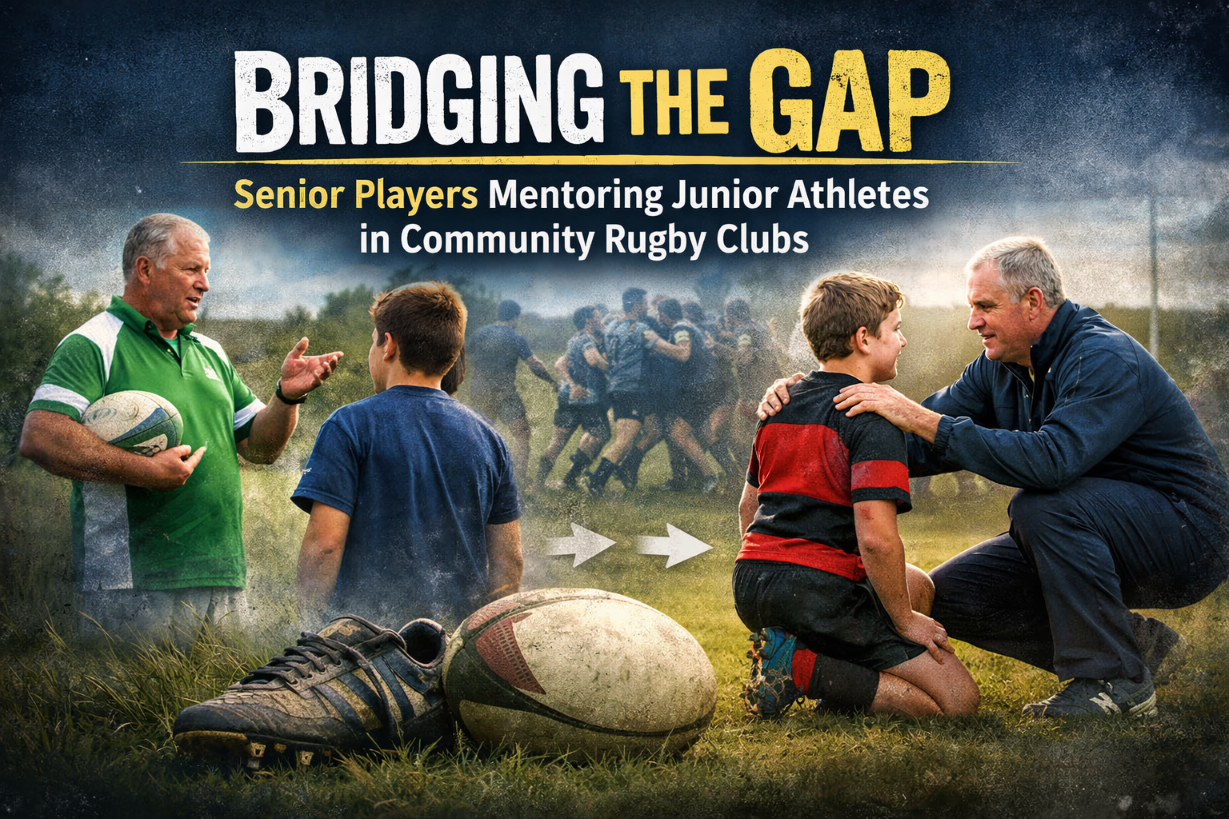
Community rugby clubs in small towns occupy a unique social and sporting space. They are not only sites of competition, but also centres of identity, intergenerational interaction, and social cohesion. When culture erodes and structures weaken, performance declines, participation drops, and the club risks losing its relevance. As part of a strategic reset at community rugby clubs, one core objective is to formalise a mentorship model where senior players, including retired and non-playing members, actively mentor junior players within the amateur club environment.
This article argues that structured senior-to-junior mentorship is not a soft add-on, but a necessary intervention for rebuilding club culture, supporting player development, and ensuring long-term sustainability. Drawing on sports coaching, mentoring, and sports club literature, the article outlines the importance of mentorship, its relevance to small-town rugby, the potential benefits and risks, and a practical way forward.
Why Senior Player Mentorship Matters
Knowledge transfer and rugby intelligence
Senior and former players carry tacit knowledge that cannot be fully replicated through formal coaching alone. This includes game understanding, positional nuance, training habits, injury management, and coping strategies for pressure and setbacks. Mentoring literature consistently shows that experiential knowledge transfer is one of the strongest outcomes of mentoring relationships in sport (Bloom, 2013; Bailey, Jones and Allison, 2019).
In amateur rugby settings, where coaching resources are often limited, senior players become critical carriers of institutional memory. Their involvement helps young players understand not only how to play the game, but how to live the standards of the club.
Identity, belonging, and club culture
Clubs with weak or fragmented cultures often suffer from short-term thinking, player drift, and low accountability. Mentorship creates relational bonds across age groups, reinforcing shared identity and norms. Walsh and Chambers (2014) argue that sustainable mentoring models in sports clubs strengthen cultural continuity by embedding values through relationships rather than rules.
For junior players, being mentored by respected senior figures increases their sense of belonging and commitment. From the protégé perspective, effective mentoring relationships are associated with trust, motivation, and personal growth (White et al., 2017).
Addressing developmental inequalities
Research on the relative age effect shows that younger or late-developing players are often disadvantaged in early selection and progression pathways (Mujika et al., 2009; Lupo et al., 2019). In small-town clubs, this effect can be amplified due to limited player pools.
Senior mentors can play a corrective role by advocating for patience, encouraging long-term development, and protecting younger players from premature dropout. This human buffer is particularly valuable in amateur environments where formal talent development systems are absent.
The Value of Retired and Non-Playing Seniors
Active contributors beyond the field
Retirement from playing does not equate to disengagement. Studies on senior sports club members show that continued participation in club activities is associated with better functional status, quality of life, and ongoing physical activity (Stolarz et al., 2022; Kwon and Jang, 2024).
By positioning retired players as mentors rather than spectators, clubs retain experience while offering seniors meaningful roles. This aligns with evidence that sports club participation among older adults promotes healthier behaviours and sustained social engagement (Kwon and Jang, 2024).
Prosocial behaviour and role modelling
Middle-aged and elderly sports club members often exhibit strong prosocial behaviours, including cooperation, support, and community-mindedness (Luo and Qu, 2025). These traits are foundational to mentorship and are particularly valuable in shaping young players’ attitudes toward teamwork, discipline, and respect.
In a small-town rugby club, where players encounter each other beyond the field, these relationships extend into everyday life, reinforcing positive behaviour across the community.
Pros of a Senior-to-Junior Mentorship Model
- Stronger club culture
Mentorship embeds values through lived example rather than enforcement. Culture becomes visible and consistent. - Improved player retention
Players who feel supported and valued are more likely to remain at the club, even during periods of limited game time or poor results. - Leadership development
Junior players learn leadership informally, while senior players refine communication and reflective skills. Mentoring has been shown to positively impact mentors themselves, not only mentees (Crisp, 2018). - Reduced coaching burden
While not replacing coaches, mentors provide day-to-day guidance that complements formal training structures (Bloom, 2013). - Community integration
The club repositions itself as a multigenerational institution, strengthening its social licence in the town.
Cons and Risks to Manage
- Role confusion
Without clear boundaries, mentors may drift into coaching or selection influence, undermining formal structures (Sandybayev and Erdem, 2015). - Resistance to change
Some senior figures may carry outdated views that conflict with modern training, welfare, or disciplinary standards. - Inconsistent quality
Not all experienced players are effective mentors. Poor mentoring can reinforce negative behaviours or biases (Leeder and Sawiuk, 2021). - Informal power dynamics
In small communities, personal relationships can complicate accountability if the model is not transparent.
These risks do not negate the value of mentorship, but they demand intentional design rather than ad hoc implementation.
A Practical Way Forward for community rugby clubs
1. Define the mentorship purpose
The club must clearly state that mentorship is about guidance, support, and cultural transmission, not coaching authority or selection influence. This aligns with best practice in sports mentoring frameworks (Bailey et al., 2019).
2. Identify and prepare mentors
Senior and retired players should be invited, not assumed. Basic mentor orientation sessions can cover communication, boundaries, and safeguarding. Even light-touch preparation improves outcomes (Bloom, 2013; Walsh and Chambers, 2014).
3. Structured but flexible pairing
Pair mentors with small groups or positional units rather than individuals to reduce dependency and pressure. Relationships should be reviewed periodically.
4. Align with coaching structures
Mentors should operate alongside coaches, with clear reporting lines. Strategic alignment prevents mixed messages and protects coaching authority (Sandybayev and Erdem, 2015).
5. Measure cultural indicators
Success should not be measured only in wins. Indicators such as training attendance, player retention, discipline, and volunteer involvement provide more accurate feedback on cultural progress.
Conclusion
For small-town amateur rugby clubs facing cultural drift and structural challenges, senior-to-junior mentorship is not nostalgic sentiment. It is a strategic intervention grounded in evidence from sports coaching, mentoring, and sports club research. When designed deliberately, mentorship strengthens identity, transfers knowledge, supports wellbeing across age groups, and reconnects the club to its community roots.
At community rugby clubs, the goal is not to recreate the past, but to use the wisdom of those who built it to guide the next generation forward.
References
Bailey, J., Jones, R.L. and Allison, W., 2019. Sports coaches’ mentorship: Experience and a suggested future framework. European Journal of Human Movement, 43, pp.67–85.
Bloom, G.A., 2013. Mentoring for sport coaches. In: R. Lyle and C. Cushion, eds. Routledge Handbook of Sports Coaching. London: Routledge, pp.476–485.
Crisp, P., 2018. Sports coach mentoring – impacts on the mentors, not the ‘mentees’. The Sport Journal, 19, pp.1–16.
Kwon, J. and Jang, J., 2024. The relationship between sports club participation, physical activity, and health behaviors among older Korean adults. Healthcare, 12(23), p.2411.
Leeder, T.M. and Sawiuk, R., 2021. Reviewing the sports coach mentoring literature: A look back to take a step forward. Sports Coaching Review, 10(2), pp.129–152.
Luo, J. and Qu, Y., 2025. A study of the prosocial behavior of middle-aged and elderly sports club members: A network analysis. BMC Public Health, 25(1), p.2594.
Lupo, C., Boccia, G., Ungureanu, A.N., Frati, R., Marocco, R. and Brustio, P.R., 2019. The beginning of senior career in team sport is affected by relative age effect. Frontiers in Psychology, 10, p.1465.
Mujika, I., Vaeyens, R., Matthys, S.P., Santisteban, J., Goiriena, J. and Philippaerts, R., 2009. The relative age effect in a professional football club setting. Journal of Sports Sciences, 27(11), pp.1153–1158.
Sandybayev, A. and Erdem, O., 2015. A strategic approach to mentoring in organizations: A case study on athletic clubs. International Journal of Advanced Research in Science, Engineering and Technology, 2(5), pp.632–639.
Stolarz, I., Baszak, E.M., Zawadka, M. and Majcher, P., 2022. Functional status, quality of life, and physical activity of senior club members. International Journal of Environmental Research and Public Health, 19(3), p.1900.
Walsh, J. and Chambers, F.C., 2014. Designing sustainable models of mentoring for sports clubs. In: Mentoring in Physical Education and Sports Coaching. London: Routledge, pp.180–188.
White, J.S., Schempp, P.G., McCullick, B.A., Berger, B.S. and Elliott, J.M., 2017. Mentoring relationships in sport from the protégé’s perspective. International Journal of Evidence Based Coaching and Mentoring, 15(1), pp.152–168.

Comments are closed