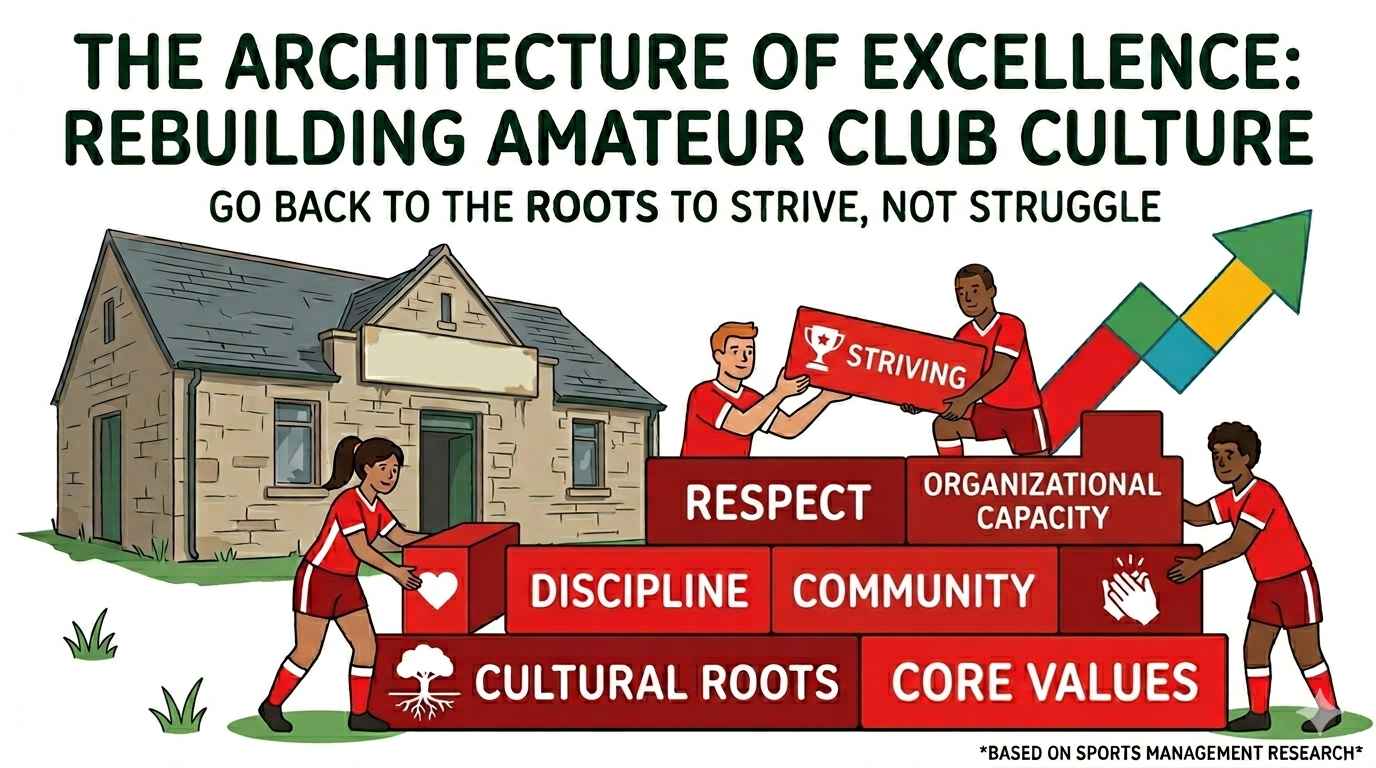
In the modern sporting landscape, the line between amateurism and professionalism has become increasingly blurred. While resources and funding often dictate the ceiling of a club’s potential, the “floor” is held steady by its culture. For many amateur rugby and multi-sport clubs, the loss of this cultural foundation results in a slow descent into mediocrity or organisational entropy — a state where energy is dissipated without achieving goal-oriented work (Frey, 1978).
To transition from a struggling entity to a striving one, a club must treat its culture not as a vague “vibe,” but as a mechanical asset. This requires the strategic adoption of elite principles, meticulous attention to micro-behaviors, and a commitment to rebuilding from the roots when the environment becomes toxic or diluted.
1. The Cultural Root System: Theoretical Foundations
Culture in a sporting context is a measurable function of success (Pennington, 2025). It is the “social capital” that binds constituents together, creating a sense of community that buffers against external challenges (Doherty & Cuskelly, 2019). Amateur clubs often face a “paradox of culture,” where the desire for high performance — which requires discipline and exclusivity — clashes with the voluntary, social nature of the organisation which traditionally values inclusion and recreation (Piggin & Thomson, 2021).
The Lifecycle of Organisational Capacity
Research into nonprofit community sports identifies three pillars of organisational capacity: human resources, financial capacity, and structural capacity (Misener & Doherty, 2009). A struggling club often sees a degradation in all three. When a club’s culture erodes — often due to leadership changes, financial instability, or a shift in community demographics — it cannot be “fixed” with a single win. Sustainable success requires a “bottom-up” approach to lifelong engagement, ensuring that the values of the club are shared by the youngest junior and the oldest board member (Roche, 2017).
2. Elite Standards in Amateur Spaces: The “Micro-Details” of Culture
The transition from a struggling club to a striving one is often found in the “unseen” areas. Elite professional clubs understand that performance is a byproduct of discipline in the cloakrooms, the practice fields, and the boardroom.
The Cloakroom and Visual Identity
Standards of dress are a visual signal of organisational pride. Professionalism begins with the requirement of specific attire for games (and meetings) (Cruickshank & Collins, 2012). When players and staff wear club colours with discipline, it fosters a collective identity and mental readiness. In a struggling club, you will see players arriving in mismatched gear; in a striving club, the kit is a uniform of intent.
The Practice Field: Psychological Safety and High Performance
Elite culture is built on “psychological safety,” where athletes feel safe to contribute, learn, and challenge without fear of retribution (Van Tuyl et al., 2024). This environment allows for the high-intensity, “fearless” coaching seen in elite swimming and rugby (Maughan & Jowett, 2024).
If a player is afraid to make a mistake during practice, they will never innovate during a match. Striving clubs cultivate an environment where “failing forward” is part of the growth process, whereas struggling clubs often have a culture of blame that stifles development (Cooke et al., 2024).
Attendance and the “Contract of Presence”
In amateur settings, where time is a scarce resource, the effective management of meetings and practice sessions is a key element of strategic management (Martínez-Moreno et al., 2021). Striving clubs treat meeting attendance as a “contract.” If a player or coach cannot commit to the time, they cannot commit to the culture. This rigidity, ironically, creates more freedom on the field because everyone knows their role and the expectations placed upon them.
3. The Economics of Culture: The “Paying Club” Dilemma
A significant point of contention in amateur sports — particularly in rugby and football — is the introduction of financial incentives. It is a reality that “paying clubs” often outperform their peers due to superior resource mobilisation (Barget & Chavinier-Rela, 2017). However, this creates a sustainability dilemma.
Is Paying Sustainable?
While paying players can attract talent, it often leads to “mission drift” where the club’s original purpose (community and development) is sacrificed for short-term trophy hunting (Wicker et al., 2013). Research indicates that clubs that diversify their revenue but maintain a clear focus on their nonprofit mission tend to survive longer (Wicker & Breuer, 2011).
The Pros of Paying: Immediate access to higher-tier coaching, increased accountability, and a more “professional” atmosphere.
The Cons of Paying: Destruction of the “volunteer spirit,” financial vulnerability if a sponsor leaves, and internal resentment between paid and unpaid members.
The “prize” at the end of the day should not just be a trophy, but the creation of a sustainable community asset. If a club stops awarding financial incentives and has no underlying culture, the players will leave. If the club has a strong culture, the players stay for the crest, not the check.
4. Rebuilding from Scratch: The Way Back
When a club has lost its “rightful place,” it is usually because it tried to maintain an elite facade on a hollowed-out cultural base. Rebuilding requires “strategic capacity building” — it cannot be expected to work overnight (Millar & Doherty, 2018).
Step 1: Defining the Inclusive Identity
Re-norming a club for inclusivity and safety is the first step toward changing a toxic culture (Breger et al., 2019). This means removing barriers that exclude potential members based on ethnicity, gender, or social class (van Slobbe et al., 2016).
Step 2: Transformational Leadership
The amateur sports leadership challenge is significant. It requires leaders who practice “exemplary leadership,” focusing on mindset enhancement rather than just tactical coaching (Rutledge, 2007; Doyle, 2025). Leaders must be “Champion Minded,” modeling the behaviors they expect to see in the cloakrooms and on the field (Walinga et al., 2021).
Step 3: Establishing Management Control Systems
Even amateur clubs need Management Control Systems (MCS). This doesn’t mean corporate bureaucracy; it means having clear KPIs for coaching, financial reporting, and member retention (Teixeira, 2024).
5. Conclusion: To the Supporters and the “Haters”
For the disillusioned supporters and the “haters” who have walked away, the message is one of accountability. A club without a soul is just a collection of individuals in the same jersey. Rebuilding a club requires a return to the roots — a focus on the small details that build a “sense of community” (Scotto di Luzio et al., 2020).
Whether a club pays its players or relies on the grit of its volunteers, the foundation must be a culture of respect, discipline, and a shared vision. If the culture is lost, the only way forward is down — to the roots — to start again.
References
Ahmić, D., Tanasilović, M., Gajić, I., Parčina, I., Tuzović, A. and Đurić, M. The Presence of Transformational Leadership in the Sports Clubs Management.
Balogh, L., 2015. Sport-Culture-sports culture. Szeged: Szegedi Tudományegyetem.
Barget, E. and Chavinier-Rela, S., 2017. The analysis of amateur sports clubs funding: a European perspective. Athens Journal of Sports, 4(1), pp.7-34.
Breger, M.L., Holman, M.J. and Guerrero, M.D., 2019. Re-norming sport for inclusivity: How the sport community has the potential to change a toxic culture of harassment and abuse. Journal of Clinical Sport Psychology, 13(2), pp.274-289.
Cooke, M., et al., 2024. Psychological safety: A qualitative study on coach and athlete perceptions. International Sport Coaching Journal, 12(3), pp.490-502.
Cruickshank, A. and Collins, D., 2012. Culture change in elite sport performance teams: Examining and advancing effectiveness in the new era. Journal of Applied Sport Psychology, 24(3), pp.338-355.
Doherty, A. and Cuskelly, G., 2019. Organizational capacity and performance of community sport clubs. Journal of Sport Management, 34(3), pp.240-259.
Doyle, A., 2025. The Influence of Transformational Leadership on Amateur Athletic Performance. Centenary University.
Frey, J.H., 1978. The organization of American amateur sport: Efficiency to entropy. American Behavioral Scientist, 21(3), pp.361-378.
Hutchens, S., et al., 2020. Transformational Leadership in Club Sports. Kentucky SHAPE Journal, 58(1).
Martínez-Moreno, A., et al., 2021. Leadership style in amateur club sports: a key element in strategic management. Sustainability, 13(2), p.730.
Maughan, A.B. and Jowett, S., 2024. Psychological safety in elite swimming: Fearful versus fearless coaching environments. International Sport Coaching Journal, 12(3), pp.399-410.
Millar, P. and Doherty, A., 2018. “You can’t just start and expect it to work”: An investigation of strategic capacity building in community sport organizations. Journal of Sport Management, 32(4), pp.348-361.
Misener, K. and Doherty, A., 2009. A case study of organizational capacity in nonprofit community sport. Journal of Sport Management, 23(4), pp.457-482.
Pennington, C.G., 2025. Team Culture as a Function of Team Success. Athens Journal of Sports.
Piggin, J. and Thomson, R.W. A Paradox of Culture: An Amateur Sports Club and Its Constituents.
Roche, S., 2017. Listening to the grass roots: Bottom-up approaches to lifelong learning. International Review of Education, 63(2), pp.145-152.
Scotto di Luzio, S., et al., 2020. Exploring the role of sport sense of community in perceived athlete burnout, sport motivation, and engagement. Journal of Applied Sport Psychology, 32(5), pp.513-528.
Teixeira, I.M.F., 2024. Management Control Systems in Amateur Sports Clubs: A Case Study. Universidade do Porto.
Van Tuyl, R., Walinga, J. and Mandap, C., 2024. Safe to Be (long), Contribute, Learn, Challenge, and Transform. International Journal of Sport & Society, 15(2).
van Slobbe, M., et al., 2016. The making of an ethnically diverse management: contested cultural meanings in a Dutch amateur football club. Routledge.
Walinga, J., et al., 2021. The Role of Leadership and Team Culture in Enhancing Sport Performance Outcomes. International Journal of Sport & Society, 12(2).
Wicker, P. and Breuer, C., 2011. Scarcity of resources in German non-profit sport clubs. Sport Management Review, 14(2), pp.188-201.
Wicker, P., et al., 2013. Organizational mission and revenue diversification among non-profit sports clubs. International Journal of Financial Studies, 1(4), pp.119-136.

Comments are closed